
Janjgir–Champa
An administrative decision taken within the district health department of Janjgir–Champa has triggered debate over transparency, conflict of interest and institutional propriety. The controversy centres on the recent posting orders issued by Dr. Anita Shrivastava, the district’s In-charge Chief Medical and Health Officer (CMHO), assigning two sensitive health portfolios to her husband, Dr. Manish Shrivastava.
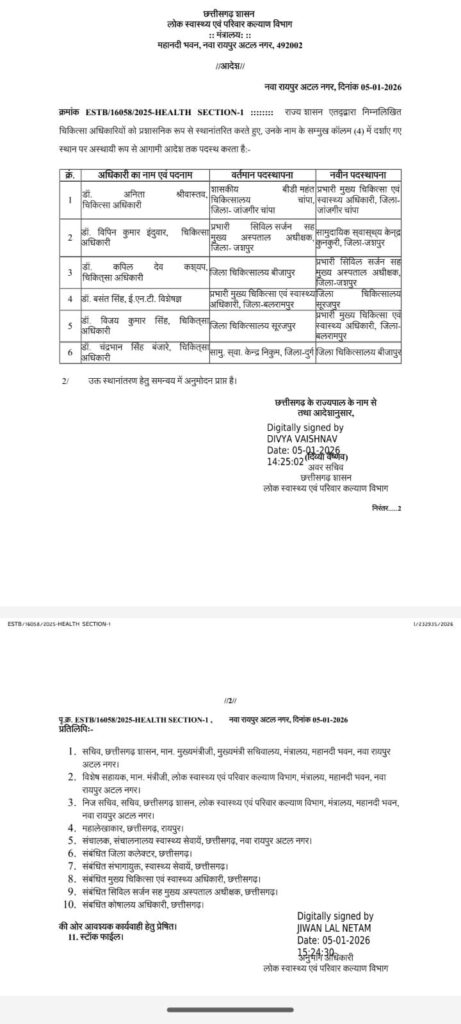
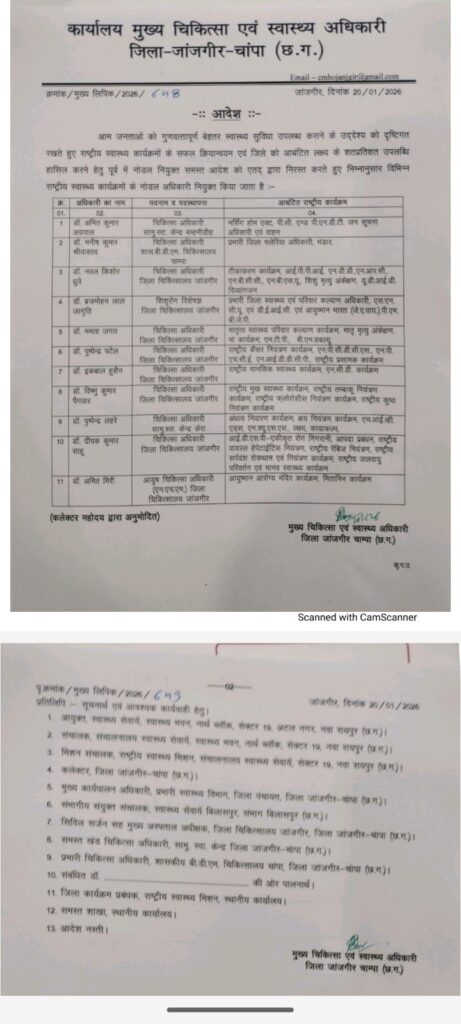
Dr. Anita Shrivastava assumed charge as In-charge CMHO on January 5, 2026, following her transfer from BDM Hospital, Champa. Within a fortnight of taking office, an order was issued attaching Dr. Manish Shrivastava to the district headquarters and appointing him as In-charge District Malaria Officer as well as District Store/Medical Supplies In-charge.
Sensitive portfolios, rising concerns
Health officials and administrative observers note that both assignments are directly linked to public health delivery, disease-control programmes, drug procurement and storage, and utilisation of government funds. The concentration of such responsibilities within the immediate family of the district’s top health administrator has raised questions regarding administrative neutrality and potential conflict of interest.
While the appointments are stated to have been made with the approval of the district collector, the lack of a public clarification on the rationale behind the decision has added to the unease within departmental circles.
Earlier complaints resurface
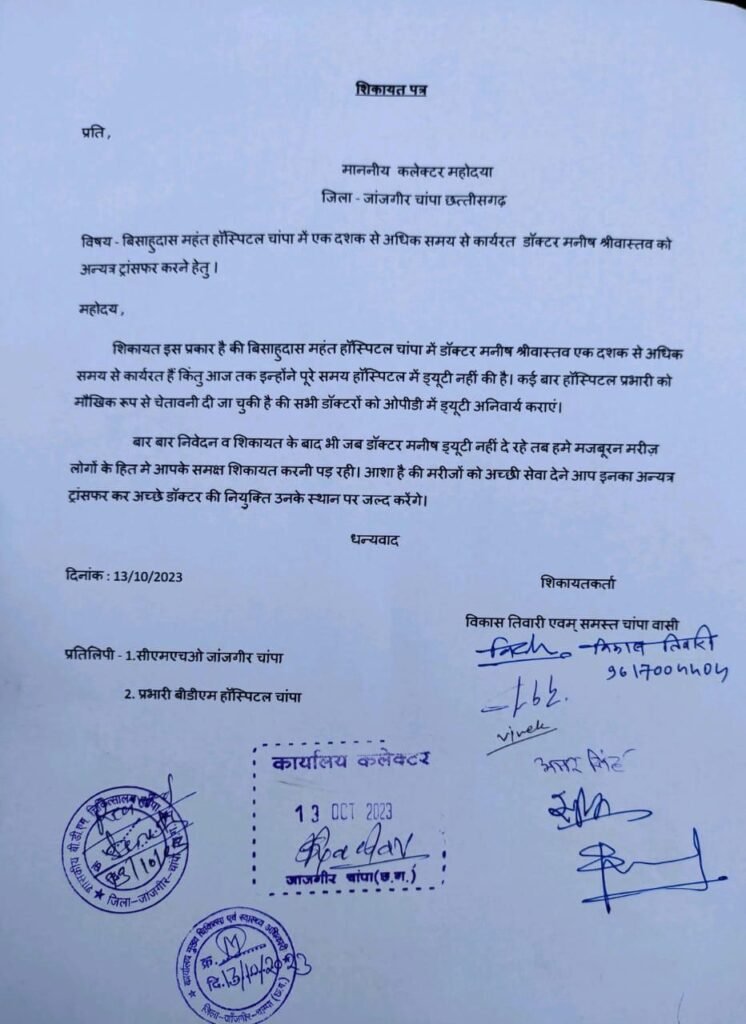
This is not the first time Dr. Manish Shrivastava’s name has figured in official complaints. During his earlier posting at BDM Hospital, Champa, local residents had submitted written representations to the district administration alleging irregular attendance at the outpatient department, resulting in inconvenience to patients.
However, there has been no public disclosure so far regarding any inquiry, findings or action taken on those complaints. The absence of official information has now renewed scrutiny following his latest appointments.
Perceptions within the department
According to departmental sources, there is a growing perception that while the CMHO formally holds office, key administrative and operational decisions may be influenced by Dr. Manish Shrivastava’s role. These claims, however, remain unconfirmed, with no official statement issued either by the health department or the district administration.
Broader implications
Observers point out that such situations risk undermining both institutional credibility and the broader narrative of administrative accountability. At a time when governments emphasise women’s leadership and independent decision-making in public service, perceptions of indirect influence can dilute the spirit of those initiatives.
Experts also stress that appointments to programmes such as malaria control and district medical stores must follow strictly transparent, well-documented procedures, given their direct impact on public health outcomes.
Awaiting official response
As of now, neither the health department nor the district administration has issued a detailed clarification addressing:
- the basis of the appointments,
- whether past complaints were examined, and
- what safeguards are in place to prevent conflict of interest.
The issue, therefore, has moved beyond a routine administrative order and has emerged as a larger test of transparency, accountability and ethical governance in the district’s public health system.