
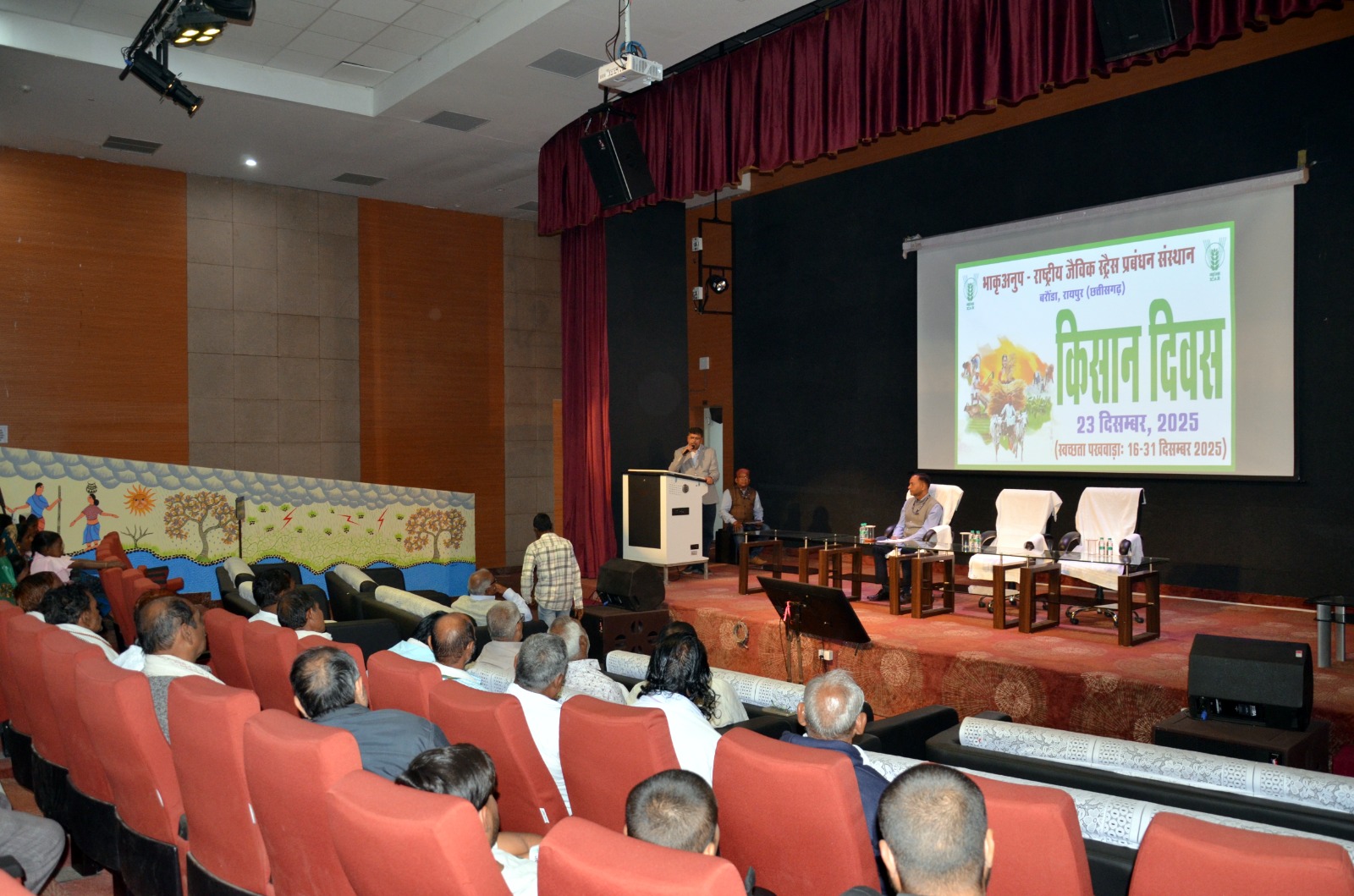
Raipur : The ICAR–National Institute of Biotic Stress Management (ICAR-NIBSM), Raipur, celebrated Kisan Diwas (National Farmers’ Day) today with a comprehensive programme focused on farmer interaction, awareness creation, and the promotion of clean agricultural practices. The event, held to mark the birth anniversary of Bharat Ratna Chaudhary Charan Singh, former Prime Minister of India, served as a platform to bridge the gap between scientific innovation and field-level implementation. Addressing the gathering, Dr. P. K. Rai, Director of ICAR-NIBSM, paid rich tributes to Chaudhary Charan Singh Ji, emphasizing that the values of dedication and service to the farming community remain the cornerstone of the institute’s mission.
During the technical sessions, Dr. Rai underscored the urgent need for crop diversification, particularly within the Chhattisgarh region. He pointed out that reducing dependency on a single crop is essential for enhancing farmers’ income and building resilience against increasingly unpredictable climatic and market risks. Farmers were encouraged to transition toward diversified cropping systems—incorporating pulses, oilseeds, and vegetables—alongside the adoption of scientific management practices for biotic stresses. Furthermore, Dr. Rai highlighted the importance of utilizing various Government of India welfare schemes that provide vital income support, insurance coverage, and credit access to strengthen rural infrastructure.
Earlier in the programme, Dr. Pankaj Sharma, Joint Director and Nodal Officer for Swachhata Pakhwada, explained the historical significance of Kisan Diwas and its connection to the legacy of Chaudhary Charan Singh Ji as a champion of land reforms and rural development. Dr. Sharma emphasized the integration of ‘Swachhata’ (cleanliness) within agricultural operations, noting that such practices are vital for maintaining soil quality and ensuring healthy crop production. The event concluded with an experience-sharing session led by Shri Dwarakanth Pandey, an innovative farmer, followed by a collective resolve from all participants to champion sustainable agriculture and farmer-centric development in the years to come.