
By : SHOBHA SHUKLA – CNS
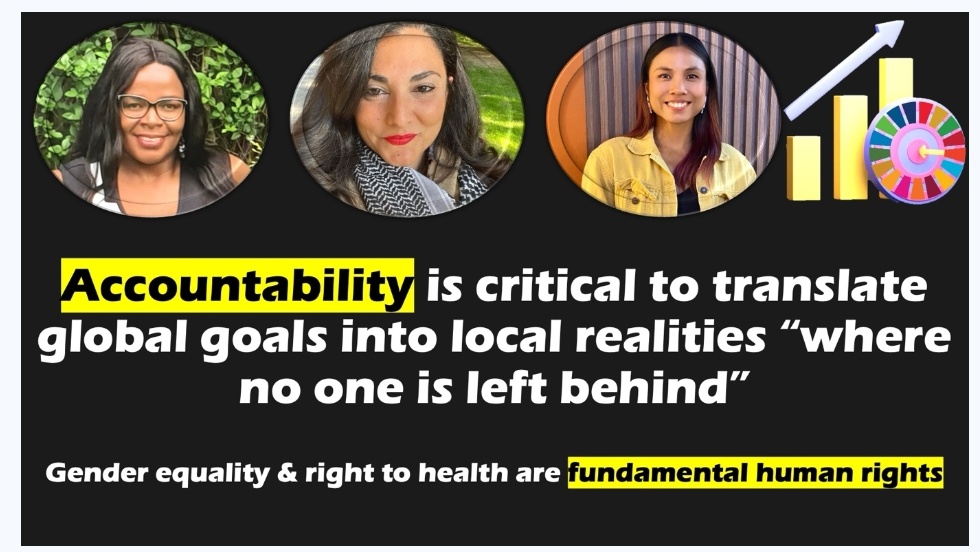
Accountability is critical when it comes to ensuring that promises made by the governments translate into ground realities “where no one is left behind.” Without robust accountability mechanisms, we risk failing on goals and targets, such as those enshrined in Sustainable Development Goals (SDGs) or other legally binding treaties (like CEDAW), agreements, declarations and other global, regional or national commitments.
“Universal Periodic Review (UPR) is one of the accountability mechanisms to hold UN member States accountable for human rights obligations and commitments,” said Dr Virginia Kamowa, Regional and Country Engagement Manager, Global Center for Health Diplomacy and Inclusion (CeHDI) while giving her keynote talk at the 1st SHE & Rights session of 2026.
193 sovereign nations that are part of the UN are referred to as UN Member States.
“All 193 UN member States are reviewed once every four years. So far, three such reporting cycles have taken place and fourth cycle is currently underway. First such review of all UN member States took place between 2008-2011, then 2012-2016, followed by a third one during 2017-2022, and now the fourth cycle is going on currently 2022-2027,” added Dr Kamowa.
“National report is written by governments for their respective country but also there are UN bodies within the country that do their own compilation. Stakeholders like civil society and human rights institutions also compile their summary report and during the process other States ask questions and make recommendations to the country that is being reviewed. The reviewed country can accept (or reject) those recommendations and then the follow-up happens in the next cycle of UPR review,” explained Kamowa in SHE & Rights session. SHE & Rights was together organised by Global Center for Health Diplomacy and Inclusion (CeHDI), Women Deliver Conference 2026, International Planned Parenthood Federation (IPPF), Asian-Pacific Resource and Research Centre for Women (ARROW), Women’s Global Network for Reproductive Rights (WGNRR), Asia Pacific Media Alliance for Health, Gender and Development Justice (APCAT Media) and CNS.
Why UPR matters for accountability?
“UPR matters for national accountability because UPR is the only UN mechanism that reviews every country on a regular cycle against human rights obligations made by the UN member States. All the commitments that are in the Universal Periodic Review are public, which means that the public have access to those recommendations. So that makes it easier to hold the governments accountable for the commitments that are there,” said Dr Virginia Kamowa of CeHDI.
“UPR creates a clear accountability pathway because we know the commitments made along with the expectation of action on those commitments. Every four years, progress is reviewed. It also links to international obligations that are made by countries that are signatory to different human rights policies.”
UPR links global obligations to national policy, budgets and service delivery
“UPR links human rights obligations at the global level to national policy and budgets, and to service delivery. UPR is timebound as these obligations are timebound in terms of implementation. Repeated UPR review cycles expose what progress has taken place on these recommendations. Governments can accept or reject the recommendations made, but it also gives a political clarity in terms of which recommendations governments are going to work upon – and all information is in public domain,” said Dr Kamowa.
“It is the governments who are accountable for implementation of these recommendations that are made (including budgeting for implementation). Public institutions must deliver services on the recommendations that are made and civil society and communities play a very critical role because they provide the monitoring, scrutiny and the follow-up that is required during the implementation period,” asserted CeHDI’s Dr Kamowa.
“Public oversight is essential in translating the UPR commitments into change because if there is no public oversight those commitments might just be stagnant without being followed up.”
UPR transforms advocacy from moral appeals to evidence-based accountability
Dr Kamowa of CeHDI shared that recommendations related to right to health have increased overtime when we compare four UPR cycles so far. More importantly, as UN member States can accept or reject these recommendations, acceptance rates of these recommendations have also shot up overtime. “Overall, 76% of recommendations that were made have been accepted and for those that are related to health, acceptance rate is even higher at 82%. There is a progress made on UPR recommendations made on maternal health and those that have been accepted,” she said.
Maternal mortality is largely preventable and is a co-indicator to right to health. High maternal mortality reflects systemic failures, limited access to sexual and reproductive health and rights, workforce shortages, lack of safe abortions and discrimination. Women who are poor, rural, young or marginalised are disproportionately affected, said Dr Kamowa.
“Due to UPR, States can routinely receive recommendations to reduce maternal mortality, improve access to quality of maternal healthcare services and expand information and services related to sexual and reproductive health and rights. They can also address gender inequality and some harmful practices. When accepted, these recommendations become like a formal commitment of a State. UPR enables us to monitor the commitments related to maternal health and other sexual and reproductive health and rights which are made and accepted by a government, what laws, policies or strategies have been adopted or strengthened, and review if maternal mortality rates declined and for which populations. In terms of turning commitments into accountability, the UPR provides authoritative language to connect local realities to international promises. It strengthens advocacy narratives too,” she further added.
In January 2026, UPR review took place in some countries like Rwanda and St Lucia. Likewise, in May 2026, UPR review would take place in Namibia, Mozambique, Somalia, Seychelles, Eswatini, among others.
Philippines did not accept UPR recommendations to decriminalise abortions
“In recent Universal Periodic Review, despite receiving direct urgent recommendations to decriminalise abortion and pass the equality law, the Philippine government did not accept these recommendations, dismissing them as contrary to our so-called, national ‘culture’ and ‘religious values’,” said Pauline Fernandez, Coordinator, Philippine Safe Abortion Advocacy Network (PINSAN). PINSAN’s campaign calls to decriminalise abortion in the Philippines.
“Sunshine, a Netflix film for which PINSAN was also consulted in initial stages stars a Filipino actress tells the story of a young girl who sought an abortion clandestinely. While emphasising power and choice, it opened the door on how to talk about abortion with a wider audience,” shared Pauline. “We have also drafted a proposed decriminalisation of abortion Bill which has engaged champions within legislature and other government agencies,” she added.
Girls’ manifesto gives hope
“UPR has historically been one of the most accessible and useful tools that human rights defenders have leveraged to hold their governments accountable. I think I would also like to use other mechanisms, for example, treaty bodies are other mechanisms which human rights defenders can use to hold their governments accountable. Special procedures have proven to be a useful mechanism for human rights defenders to hold States accountable via their country visit reports,” said Paola Salwan Daher, Senior Director for Collective Action, Women Deliver.
“Prior to my current role I was doing advocacy at Human Rights Council and other such spaces for a long time. I often felt tensions during (intergovernmental) negotiations when it pertained to the right to bodily autonomy of girls or to the agency of girls. So, there is a specific resistance to recognise girls, as rights holders, as human beings that have their own agency, or those who can make their own decisions. Women Deliver is part of a broader community called the “Girls Deliver Community” and through and within this community, girls have written a “Girls’ Manifesto” where they articulate their demands and principles around which they want to organise their activism. This manifesto needs to be centred in negotiations and global spaces as well because it comes from them,” added Paola. Women Deliver Conference 2026 would be held in Naarm (Melbourne), Australia in April 2026.
Be aware: Use free Health & Rights Observatory
Health & Rights Observatory, designed and created by the Global Center for Health Diplomacy and Inclusion (CeHDI), advances and amplifies the mainstreaming of the right to health in the Human Rights Council processes, treaty bodies and special procedures as a gateway for universal health coverage and global health equity. This platform presents data on the Right to Health within the context of UPR. Check it out on www.cehdi.org
Gender equality and right to health are fundamental human rights. Despite decades of efforts, we are way off the mark on both: gender equality and right to health. This is so unaccepable. It is high time we collectively use and fortify accountability mechanisms and push the governments to deliver on the promises made at the global level.