
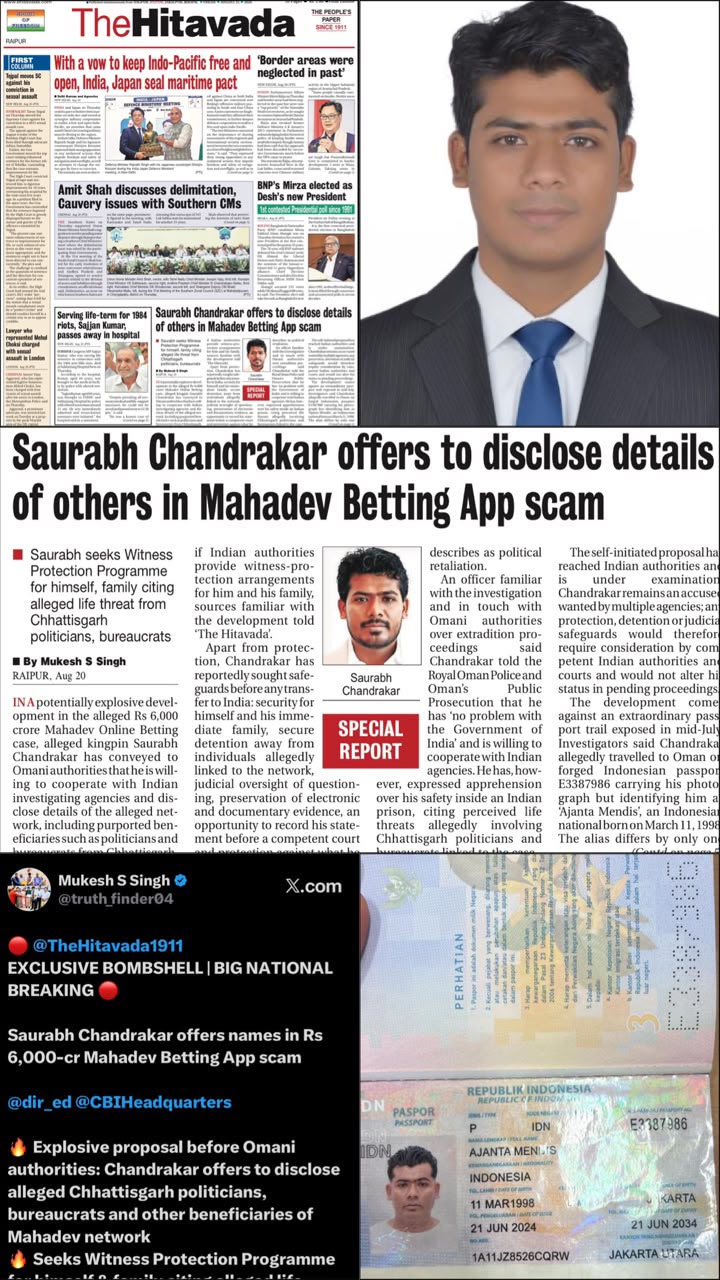
Alleged kingpin offers cooperation with Indian agencies, purported information on politicians, bureaucrats and other beneficiaries; CBI, ED, MEA examining legal options as extradition process continues
RAIPUR/NEW DELHI : In a startling disclosure in the alleged Rs 6,000-crore Mahadev Online Betting case, alleged kingpin Saurabh Chandrakar has reportedly offered to cooperate with Indian investigating agencies and disclose information about people allegedly linked to the network, subject to security arrangements for himself and his family.
Sources said the information Chandrakar claims to possess could include details concerning alleged politicians, bureaucrats and other beneficiaries from Chhattisgarh. However, any such claims, names or evidence would require independent investigation and corroboration before any conclusions could be drawn.
Chandrakar, who is in Oman and has been wanted by Indian agencies since 2023, reportedly conveyed his willingness to cooperate before Omani authorities at a time when India is pursuing legal and diplomatic avenues to bring him back.
The Hitavada first broke national-level development
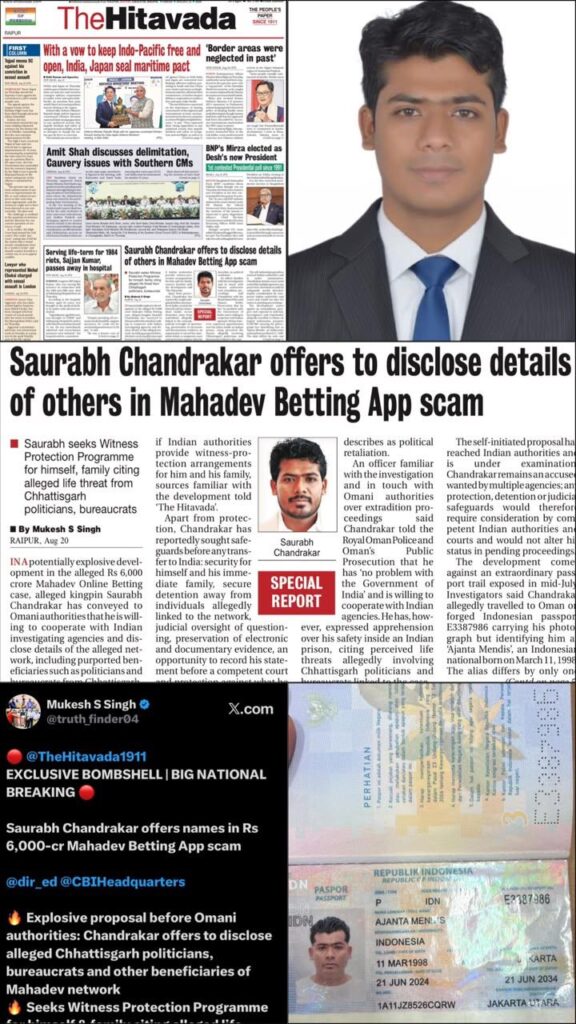
The potentially explosive development was first broken nationally by The Hitavada, Central India’s leading English newspaper, through an exclusive investigation published in its Chhattisgarh Edition.
The exclusive was broken by Mukesh S Singh, Deputy Resident Editor of The Hitavada and a widely acclaimed investigative journalist from Chhattisgarh, based on information from sources familiar with the case and developments surrounding the extradition proceedings in Oman.
Journalist Mukesh S Singh also subsequently highlighted the disclosure on his X handle @truth_finder04 , bringing renewed attention to a crucial question surrounding the case: if Chandrakar is indeed prepared to identify alleged beneficiaries, what evidence does he possess to substantiate his claims?
Protection for cooperation
According to The Hitavada’s exclusive report, Chandrakar has sought a series of safeguards before any transfer to India.
These reportedly include security for himself and his immediate family, secure detention away from individuals allegedly connected with the network, judicial oversight of questioning, preservation of electronic and documentary evidence, an opportunity to record his statement before a competent court and protection against what he describes as political retaliation.
Chandrakar reportedly conveyed to the Royal Oman Police and Oman’s Public Prosecution that he has no problem with the Government of India and is willing to cooperate with Indian investigating agencies.
He has, however, expressed apprehensions over his safety in an Indian prison, citing perceived threats allegedly involving politicians and bureaucrats from Chhattisgarh purportedly linked to the case.
Significantly, allegations or statements made by an accused do not by themselves constitute proof. Any names disclosed by Chandrakar, and any electronic, financial or documentary material produced by him, would have to withstand independent scrutiny by investigating agencies and, ultimately, judicial examination.
Proposal reaches Indian authorities !!!
Sources said Chandrakar’s self-initiated proposal has reportedly reached Indian authorities and its legal and practical implications are being examined.
His offer of cooperation does not automatically alter his legal status in the criminal proceedings pending against him. Chandrakar remains an accused wanted by multiple Indian agencies, and any witness-protection arrangement, secure detention mechanism or judicial safeguard sought by him would require consideration by competent Indian authorities and courts.
This distinction assumes particular significance because his purported offer could potentially open another investigative trail, but only if the information and evidence he provides are found credible and independently verifiable.
Forged passport trail raises fresh questions
Running parallel to the extradition proceedings is an extraordinary passport trail surrounding Chandrakar’s alleged journey to Oman.
Investigators said a suspected forged Indonesian passport, bearing number E3387986, carried Chandrakar’s photograph but identified the holder as “Ajanta Mendis”, purportedly an Indonesian national born on March 11, 1998.
The name differs by just one letter from Ajantha Mendis, the former Sri Lankan international cricketer and mystery spinner. Officials have stressed that the former cricketer has no connection whatsoever with the case.
Investigators suspect that the counterfeit passport was prepared in the United Arab Emirates nearly two years before Chandrakar’s detention and could have been one among several forged travel documents allegedly available to him.
They suspect the document was used to leave the UAE, where Indian agencies had been tracking his movements, before he was subsequently detained by the Royal Oman Police following his alleged entry into Oman.
One photograph, two identities and different birth dates
The passport records have also brought a striking identity discrepancy under scrutiny.
The suspected Indonesian document allegedly carries Chandrakar’s photograph under the identity “Ajanta Mendis”, with the date of birth recorded as March 11, 1998.
Another passport record bearing his own identity lists him as Saurabh Chandrakar, born in Bhilai, Chhattisgarh, on January 13, 1995.
The alleged passport fraud has triggered separate criminal proceedings in Oman, adding another legal dimension that could have a bearing on the timeline and route through which India may ultimately secure Chandrakar’s return.
Extradition, deportation and temporary surrender under examination
Indian authorities are pursuing multiple legal possibilities.
While formal extradition remains the principal route, officials are also examining whether deportation could become legally available depending on the outcome of Omani proceedings concerning Chandrakar’s travel documents and immigration status.
Another option examined is temporary surrender, under which Chandrakar could potentially be transferred to India for trial, subject to applicable treaty provisions and approval by Oman.
A group of around a dozen officials is involved in the process, with the Central Bureau of Investigation (CBI), India’s nodal agency for extradition matters, coordinating with the Enforcement Directorate (ED) and the Ministry of External Affairs (MEA) on legal and diplomatic options.
The CBI has also coordinated the transmission of judicial material through diplomatic channels.
India-Oman treaty provides extradition framework
India is pursuing Chandrakar under the India-Oman Extradition Treaty, signed in Muscat on December 26, 2004. The instruments of ratification were exchanged on September 14, 2005.
Chandrakar, wanted since 2023 and subject to an Interpol Red Notice, remains a central figure in investigations by the ED, CBI and Chhattisgarh’s State Economic Offences Investigation and Anti-Corruption Bureau (SEOIACB).
The Mahadev Online Betting case has spawned multiple investigations concerning the alleged operation of an illegal online betting network, panels and branches, movement of proceeds and alleged corruption.
The ED has also reported attachment of assets worth around Rs 1,700 crore linked to Chandrakar in the course of its investigation. Separately, the CBI has filed charge sheets against multiple accused in cases concerning the alleged illegal betting syndicate and associated corruption.
The big question: Who are the names, and where is the evidence?
Chandrakar’s purported offer now raises potentially consequential questions for investigators.
Who are the alleged politicians, bureaucrats and other beneficiaries he claims he can identify? What documentary, electronic or financial evidence does he possess? Can such material be independently authenticated and corroborated? And is his offer a genuine attempt to cooperate with investigators or part of a legal strategy as India presses for his return?
If Chandrakar eventually provides verifiable electronic records, financial trails, documents or other admissible evidence supporting his claims, investigators could potentially acquire new leads in the sprawling Mahadev case.
For now, however, the identities he may disclose remain unknown and his purported claims remain unverified.
What is clear is that Chandrakar’s reported offer to cooperate, coupled with his demand for protection and the complicated passport and extradition proceedings in Oman, has introduced a significant new dimension into one of the country’s most closely watched betting investigations.